
One of the most important elements in having a safe and healthy workplace is having a clearly defined process for identifying and controlling workplace hazards.
Without a defined process for identifying and controlling hazards, employees face a higher risk of injury and illness, and organizations are often forced to be reactive when correcting safety issues, rather than be proactive in identifying and correcting safety hazards before they lead to an incident.
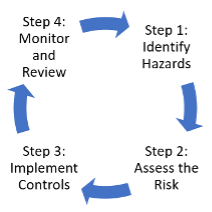
Effective hazard control is a continuous process that follows four main steps:
Step 1: Identify the hazards involved with the work, task, or activity.
Step 2: Conduct a risk assessment to determine the level of risk, or the level of harm, that employee exposure to a hazard would incur. This step is critical to accurately determine the most effective controls to implement for each hazard.
Step 3: Implement measures to control the hazards, referring to the Hierarchy of Controls (pictured below).
Step 4: Monitor and Review – Monitoring and reviewing for effectiveness is a critical step in determining whether the measures implemented have controlled hazards effectively, or whether additional measures are necessary.
Conducting Risk Assessments:
Risk assessments should be conducted and documented whenever possible, and should always be documented for work that falls under the following categories:
- There is a moderate to high risk of harm
- A new task or process is introduced, or a significant change is made to an existing task or process, such as new or modified equipment, chemicals, or other hazardous substances.
- The task or work is complex, presents many hazards, or involves multiple stages, phases, or workgroups.
- When required by legislation (such as OSHA) or by accrediting or administrative bodies.
Two examples of commonly used risk assessment tools are the 5×5 Risk Matrix, and the Job Hazard Analysis. Templates of both types of assessments are available for organizational use.
The Hazard Identification and Control Procedure has been developed to assist department management and leadership by providing a framework for identifying and controlling hazards in their areas. Departments must take adequate steps to ensure their areas are free from recognized and foreseeable hazards.
By following this procedure and the additional resources provided, departments can ensure that there is a high level of awareness of existing hazards, as well as any new hazards that may present themselves when conditions in the workplace change. Following the processes described in this procedure ensures that proactive measures can be taken to control hazards before an incident occurs.
Identifying and Controlling Hazards – For Researchers
It is crucial for research and laboratories on campus to have a system in place for ensuring that safety and health considerations take place before beginning an activity or experiment. This includes taking steps to ensure that hazards are identified and controlled effectively.
Research encompasses a wide array of interactions with not just UMBC labs and campus but also the world around us. While research is a cornerstone of the UMBC community, one must consider the potential to encounter a wide array of hazards. If not appropriately controlled, the risk has the potential to be catastrophic to both people and property. The University can also potentially be subject to substantial loss, including fines, litigation, loss of grant funding, and reputational damage.
ESH provides many tools and resources for researchers and laboratories to promote effective hazard identification so that risks from research are eliminated or mitigated to an acceptable level. For more information, refer to the SOP Guidance for Research reference handout.
Additional Forms, Templates, and Resources
5 x 5 Risk Matrix and Hazard Control Plan Template
PPE Hazard Assessment and Selection Guide
Research Safety Risk Assessment Tool
SOP Template – Biological Substance